

Wholesale SMM Services Explained: A Guide for Resellers
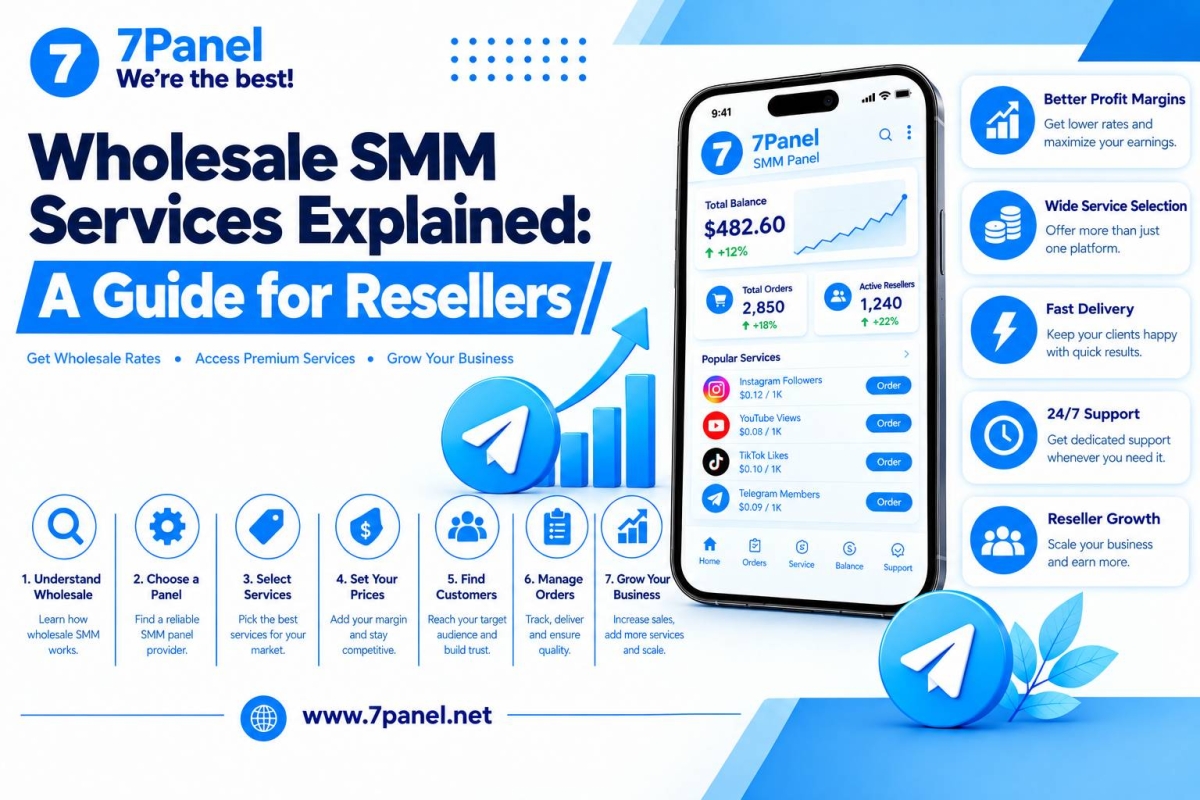
With Wholesale SMM Services, you can buy social media services from a supplier company and provide them to your own customers. Rather than creating every service and having to take care of all the fulfillment processes, your business can utilize an already existing supplier and concentrate on sales and marketing.
The approach is particularly applicable for those companies who want to offer their customers services on different platforms, including Instagram, Telegram, TikTok, YouTube, and other supported social networks.
Still, wholesale prices are not everything you need to take into account. Service terms, order management process, support, price transparency, and problem resolution cost play important roles in determining if you will be able to conduct your business effectively and sustainably.
This article provides information about what wholesale SMM services are and how the business model functions. It will also help you figure out how to calculate resale prices and how to pick a supplier.

What Are Wholesale SMM Services?
Wholesale SMM services are social media marketing services purchased from a supplier for further sale or internal company needs. These services could be followers-related, likes-related, views-related, comments-related, subscriptions-related, or related to other social media metrics depending on the supplier's service catalog.
Wholesale usually means purchasing of services in such a way that a business would be able to resell them or use them in its service package for its clients. It doesn't necessarily imply any discounts due to bulk purchases.
A wholesale service supplier will provide a system for ordering services, API for integration, and a system to check the status of your order. Some suppliers even support resellers' websites and branded child panels.
For instance, a digital marketing agency can employ the services of a supplier in order to fulfill some client requests, using its resources to work on planning and communicating with clients, etc.
The list of services and their prices and terms of fulfillment will depend on the particular service and supplier.
How Do Wholesale SMM Services Work?
The wholesale SMM model usually involves three main parties:

- The service provider: Supplies or coordinates the fulfillment of the selected service.
- The reseller or agency: Purchases services, sets its own prices, and manages its customers.
- The end customer: Buys the service through the reseller or agency.
A typical order follows this process:
- The reseller selects a service from the supplier's catalog.
- The reseller determines a retail price based on the supplier cost and other expenses.
- A customer places an order through the reseller's website or sales channel.
- The reseller submits the order manually or forwards it through an API.
- The supplier processes the order according to the service's stated conditions.
- The reseller monitors the status and communicates relevant updates to the customer.
This arrangement lets resellers focus on their own brand and customer experience without necessarily building a complete fulfillment system from scratch.
However, the reseller remains responsible for communicating service limitations accurately, managing customer expectations, and following the supplier's policies.
Wholesale SMM Services vs. Retail SMM Services
The main difference is the intended customer and the business model.
| Feature | Wholesale SMM Services | Retail SMM Services |
|---|---|---|
| Typical customer | Resellers, agencies, businesses | Individual buyers and end customers |
| Main purpose | Resale or service fulfillment | Direct purchase for personal or business use |
| Pricing | May be structured for resale margins or volume | Set for the end customer |
| Order volume | Can support repeated or larger-volume orders | Often focused on individual orders |
| API access | May be available | Depends on the platform |
| Branding options | May include reseller or child-panel features | Usually the seller's own brand |
| Main consideration | Total cost, operations, and resale viability | Price, service fit, and order conditions |
These differences are not universal. Some suppliers serve both wholesale customers and individual buyers, and not every wholesale provider offers volume discounts or branded panels.
Before choosing a platform, check the actual features and pricing rather than relying on the label wholesale alone.
Who Uses Wholesale SMM Services?
Wholesale SMM services can be useful for several types of businesses.
1. SMM Resellers
Resellers purchase services from a supplier and sell them to their own customers. They may operate a dedicated website, use a child panel, or accept orders through other channels.
Their responsibilities typically include setting prices, promoting their services, monitoring orders, and answering customer questions.
2. Digital Marketing Agencies
Agencies may use third-party suppliers for selected fulfillment tasks while concentrating on campaign strategy, content planning, account management, and client reporting.
Before incorporating a service into a campaign, an agency should evaluate whether it meets the client's goals and the relevant platform's rules.
3. Freelancers and Social Media Managers
Freelancers managing multiple clients may use external suppliers for specific services when appropriate. The supplier can handle the service order while the freelancer manages communication and broader marketing work.
4. Businesses Operating Their Own SMM Websites
Entrepreneurs who want to operate an SMM website may use an existing provider's catalog and supported ordering tools rather than developing the entire system independently.
Depending on the platform, this can involve manual ordering, API integration, or a child panel.
How to Choose a Wholesale SMM Provider
Choosing a provider requires more than comparing the lowest displayed rate. The supplier's terms and operational reliability can affect your costs, reputation, and ability to serve customers.
1. Review the Service Catalog
Check whether the provider offers services that match your target market.
If your customers mainly need Telegram services, prioritize relevant options. If you serve multiple types of businesses, a broader catalog may be useful.
Review service descriptions carefully. Two listings with similar names may have different delivery methods, limits, targeting, or conditions.
2. Compare Pricing Transparently
Confirm how the price is calculated and whether it is quoted per 1,000 units, per order, or according to another unit.
Also review:
- Minimum and maximum order quantities
- Any deposit or payment fees
- Refill or replacement conditions
- Cancellation and partial-order policies
- Whether rates can change
- Any requirements that affect the final cost
A low headline rate may not represent the lowest total cost if additional expenses or service limitations apply.
3. Check API and Order Management Features
If you expect to process many orders, API integration may reduce manual work.
Before integrating, review the documentation, supported operations, authentication requirements, rate limits, and error-handling behavior. Confirm that the API can support the workflow you intend to build.
If you are starting with a small number of orders, a dashboard and manual process may be sufficient at first.
4. Evaluate Customer Support
Check how the provider handles delayed, incomplete, or failed orders. Understand which issues can be resolved through the dashboard and which require contacting support.
A clear process for reporting problems is important when you are responsible for communicating with your own customers.
5. Understand the Supplier's Role
The term provider does not always mean a company directly operates every part of a service. Some platforms work with upstream suppliers or combine multiple sources.
Ask relevant questions about service sourcing, order processing, and the conditions that apply to each service. Evaluate the information available rather than assuming that marketing terminology proves a supplier's position in the supply chain.
A SMM reseller panel is one option to investigate when comparing reseller-oriented tools and services. Review the current catalog, pricing, available integrations, and operating terms to determine whether it fits your business.
How to Calculate Wholesale SMM Pricing and Profit
Your resale price should cover the supplier cost and the other expenses associated with serving the customer.
A simple starting formula is:
Profit per order = Customer payment − Total order costs
Consider this illustrative example:
| Item | Amount |
|---|---|
| Customer payment | $10.00 |
| Supplier service cost | $6.00 |
| Payment and allocated operating costs | $1.00 |
| Estimated profit before other unaccounted expenses and taxes | $3.00 |
In this example, the estimated profit is $3.00. Actual results will depend on the service, payment method, support requirements, order outcome, and other expenses.
Understand Markup and Profit Margin
Markup and profit margin measure different things.
If a service costs $6 and you sell it for $10:
- Markup on supplier cost: approximately 66.7%
- Gross profit as a share of the selling price: 40%, before other costs
This distinction matters because a large markup does not automatically translate into a high net profit.
Calculate the Full Cost
When planning prices, consider expenses such as:
- Supplier charges
- Payment processing fees
- Currency conversion costs
- Refunds and order adjustments
- Customer acquisition
- Support and administration
- Website and software costs
Do not assume that every order will complete exactly as expected or that every customer will return. Use actual order records to revise your cost estimates over time.
Avoid Competing on Price Alone
Offering a lower price may attract attention, but it can also leave too little room for support and unexpected costs.
Instead, consider the overall value you provide through clear service descriptions, a straightforward ordering process, responsive support, and honest communication.
How to Resell Wholesale SMM Services
Once you have chosen a supplier, decide how customers will discover your services and place orders.
Option 1: Manage Orders Manually
Manual ordering can work when order volume is low. Customers place orders through your chosen sales channel, and you submit the corresponding requests to the supplier.
Maintain accurate records of payments, service details, order references, and status updates. As the workload increases, review whether manual handling remains practical.
Option 2: Use a Child Panel
A child panel can provide a customer-facing storefront using an existing platform's infrastructure.
Depending on the available features, you may be able to use your own domain, apply your branding, set retail prices, and manage customer orders through a dashboard.
Before choosing this model, verify which features are included and what costs or restrictions apply.
Option 3: Integrate an API
An API can connect your own website or application to the supplier's system.
It may support service-list retrieval, order submission, and status checks, depending on the provider's documentation.
API integration requires testing and ongoing monitoring. Your system should account for failed requests, duplicate submissions, incomplete orders, and changes in service availability.
Choose the model that matches your current resources and upgrade when the business case supports it.
Common Mistakes to Avoid
Wholesale SMM services can simplify fulfillment, but poor planning can still lead to losses and dissatisfied customers.
Choosing only by the lowest rate: A cheaper service may have different conditions or create more support work. Compare the full service terms.
Ignoring additional costs: Payment fees, refunds, software, and customer support can reduce the money you retain.
Offering too many services too early: A large catalog can be difficult to maintain before you understand customer demand and service requirements.
Making unsupported promises: Do not guarantee permanent engagement, specific outcomes, or delivery times unless the applicable service terms genuinely support those claims.
Failing to monitor orders: A submitted order is not necessarily a completed order. Track statuses and communicate important updates.
Ignoring platform rules: Review the relevant social network's policies before offering services. Some artificial engagement practices may violate platform rules and can lead to restrictions or removal of engagement.
Expanding without measuring results: Add services and automation based on demonstrated demand, operational capacity, and actual financial performance.
How to Build a Sustainable Wholesale SMM Business
A sustainable reseller business requires consistent operations, sensible pricing, and a clear understanding of customer needs.
Start with a focused selection of services and a manageable order process. Track order outcomes, customer feedback, costs, and the time required to resolve problems.
As you gain experience, you can consider expanding your catalog, improving your website, integrating supported API features, or introducing a branded child panel.
If you are comparing a Best SMM Reseller Panel, assess the current features, service conditions, pricing, API documentation, and support arrangements before committing funds.
Do not expand simply because a supplier offers a large catalog. Add services when they fit your audience and you can explain their conditions clearly.
Frequently Asked Questions
Wholesale SMM services are social media-related services purchased from a supplier for resale or business use. The available services and pricing structure depend on the provider.
Resellers generally charge customers more than the total cost of supplying the service. The difference is not necessarily net profit because payment fees, support, refunds, and operating expenses must also be considered.
Not always. A wholesale-oriented provider may supply services to other businesses, while a reseller panel may provide a storefront for selling services to end customers. Some platforms perform both roles.
No. You can start by managing orders manually if the volume is manageable. An API becomes useful when you need to connect your own system to a supplier and automate supported operations.
Compare service details, pricing, order limits, refill and cancellation terms, API documentation, support, and transparency about service sourcing. If possible, evaluate the provider with a small, controlled test before increasing your spending.
No. The term wholesale does not guarantee the lowest price. Compare equivalent services, conditions, fees, and the total cost of fulfilling an order.
Read the service description, confirm its limitations and delivery terms, review the relevant platform rules, calculate your total cost, and ensure you can explain the offer accurately to customers.

Conclusion
Wholesale SMM services offer resellers, agencies, and online businesses a way to obtain selected social media services, without having to develop the entire fulfillment process by themselves.
A good supplier will be able to structure order management and streamline business processes for you, although there is much more to it than just the presented price rate.
Evaluate suppliers according to the true services they offer, start from those which suit your target audience, and track actual performance before scaling up. A cautious approach will allow you to make the right choices regarding wholesale SMM services for your business.



Join us on Telegram
Get updates and tips on our channel.
Article tools
Share this article