
Telegram Channel vs Group for Growth: Which Is Better?
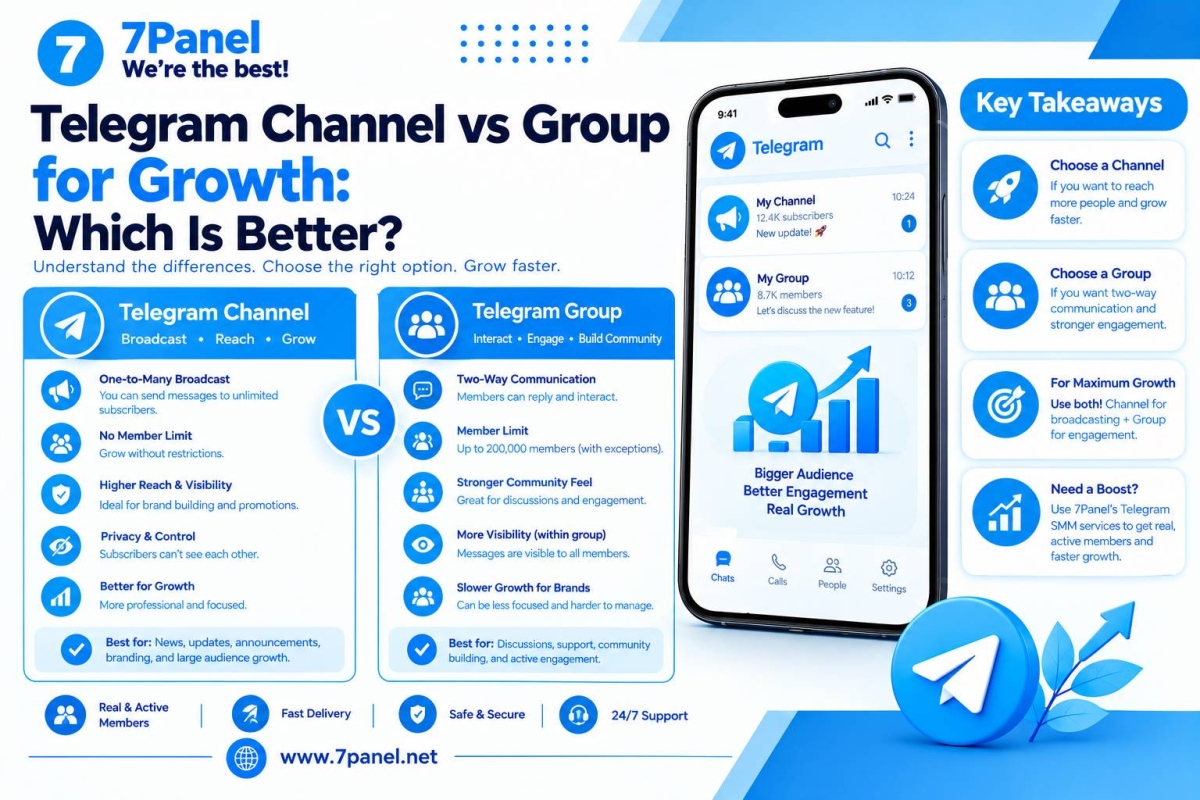
Telegram Channel vs Group for Growth: Which Should You Choose?
If you decide to develop your audience via Telegram, the very first question will be whether to use a channel or a group. Both of them can help you create an audience, post content, and promote your business, but both are aimed at different goals.
Telegram channel is usually intended to broadcast posts to a wide audience, whereas Telegram group is created for communication and participation. The right format choice will help you engage the relevant users, post content, and keep them engaged.
In this article, we will compare Telegram channels and groups for growth, tell about their benefits, and when both channels and groups can be used together.

What Is the Difference Between a Telegram Channel and a Group?
The main difference is how communication works.
A Telegram channel allows administrators to publish updates to subscribers. It is useful for announcements, news, educational content, product updates, and other information intended for a broad audience.
A Telegram group allows members to participate in conversations. Members can ask questions, share opinions, respond to other users, and interact with the community, depending on the group's permissions.
Telegram's official FAQ states that groups can support up to 200,000 members, while channels can have an unlimited number of subscribers. Channels also display post view counts, including views from forwarded copies.
| Feature | Telegram Channel | Telegram Group |
|---|---|---|
| Main purpose | Broadcast content | Build a community |
| Communication | Primarily admin-to-audience | Member discussions |
| Best for | News, announcements, updates | Questions, support, discussion |
| Content management | Centralized publishing | Shared conversation, with admin controls |
| Growth focus | Reach and subscribers | Participation and community size |
| Useful measurements | Subscribers, post views, forwards | Members, active discussions, participation |
| Best fit | Brands and publishers | Communities and customer groups |
Neither format is automatically better for every project. The right choice depends on what you want your audience to do.
When Is a Telegram Channel Better for Growth?
A channel is often the better starting point when your main goal is to distribute content consistently and reach a growing audience.
1. You Want to Reach More Subscribers
Channels are useful when you publish information for people who primarily want to receive updates rather than participate in every discussion.
For example, a news publisher can post breaking news, an online store can announce new products, and an educator can share lessons or learning resources.
Subscribers can receive updates without the conversation becoming crowded with unrelated replies.
2. You Publish Content Regularly
If your content strategy depends on scheduled posts, a channel makes it easier to organize communication around a consistent publishing plan.
You can publish tutorials, promotions, videos, news, announcements, or curated resources in one central place.
A clear content schedule also helps subscribers understand what to expect from your channel.
3. You Want to Track Post Visibility
Telegram channels provide view counters for posts. These figures can help administrators compare the visibility of different types of content.
For example, you might compare the views of a product announcement with those of a tutorial or an educational post.
However, views do not necessarily represent unique people or prove that someone engaged with the message. Consider them alongside forwards, link clicks, enquiries, and other relevant measurements.
4. You Need a Clear Brand Presence
A channel can provide a consistent identity for a business, creator, publisher, or organization.
Administrators can publish under the channel's name and profile image, making it easier for subscribers to identify the source of updates.
A Telegram channel is usually the stronger choice when your priority is content distribution, visibility, and subscriber growth.
When Is a Telegram Group Better for Growth?
A group is often more suitable when growth depends on relationships, discussions, feedback, or ongoing participation.

1. You Want to Build an Active Community
Groups allow members to exchange messages and participate in discussions, subject to the permissions set by administrators.
This format can work well for learning communities, customer groups, product users, local communities, and interest-based discussions.
Members can contribute their own questions and experiences instead of only receiving announcements.
2. You Need Direct Feedback
A group can make it easier to collect questions, suggestions, and feedback from your audience.
For example, a software business might use a group to discuss product updates, while a course creator could let learners ask questions about lessons.
Useful discussions may reveal what your audience needs and help you improve your content, product, or service.
3. You Want Members to Interact With Each Other
In a group, one member's question can help other members with the same problem. Members may share advice, experiences, and useful resources.
This interaction can strengthen a community when the topic is relevant and the group is well managed.
However, more messages do not always mean better engagement. Unmoderated discussions, spam, and unrelated promotions can reduce the quality of the experience.
4. You Need Community Support
Groups can be useful for answering common questions, helping customers, and giving users a place to discuss specific topics.
To manage a growing group, establish clear rules, assign suitable administrator permissions, and use moderation tools where needed.
A Telegram group is usually the stronger choice when your priority is conversation, feedback, and an active community.
Telegram Channel vs Group: Which Is Better for Business Growth?
For businesses, the choice depends on the role Telegram plays in the customer journey.
A channel can distribute product announcements, offers, educational content, and company updates to subscribers. A group can provide a space for customer questions, discussions, peer support, and community feedback.
Consider these examples:
- Online store: Use a channel for product updates and promotions. Add a group if customers would benefit from discussions or community support.
- Education business: Use a channel for lesson announcements and learning materials. Use a group for questions and student discussions.
- News or content publisher: Use a channel to distribute updates to a broad audience. A discussion group can provide a separate place for feedback.
- Creator or interest-based community: Use a channel for official posts and a group for conversations between followers.
Before choosing, consider your team's time and moderation capacity. A group can require considerably more day-to-day management than a channel where only administrators publish content.
Should You Use a Telegram Channel and Group Together?
For many projects, combining both formats can be more effective than choosing only one.
The channel acts as the main source of updates, while the group provides a space for discussion and feedback.
For example, an educational project might publish new lessons in its channel and direct students to a group for questions. A business might announce promotions through its channel and use a group to discuss product-related questions.
Telegram supports linking a discussion group to a channel so subscribers can access comments on channel posts. This setup can connect broadcast content with community interaction without putting every conversation directly into the main channel.
A practical combined strategy looks like this:
- Publish important updates in the channel.
- Use relevant discussion spaces for questions and feedback.
- Keep the channel focused on useful, well-organized content.
- Establish clear group rules and moderate discussions.
- Measure channel visibility separately from group participation.
You do not need to create both immediately. Start with the format that matches your main goal, then add the second when there is a clear reason for it.
How to Grow a Telegram Channel or Group
Regardless of the format you choose, sustainable growth starts with a clear purpose and a good audience experience.
1. Define Your Target Audience
Decide who the channel or group is intended for and what value it provides. A specific topic makes it easier for potential members to understand why they should join.
2. Optimize Your Name and Description
Use a recognizable name and a clear description explaining what people can expect. For public communities, a relevant and memorable username can also make sharing easier.
3. Publish Useful Content Consistently
For channels, focus on useful updates and posts that people want to read or share. For groups, establish topics that encourage meaningful discussion.
Consistency is more important than publishing large amounts of low-value content.
4. Promote Your Telegram Presence
Share your public channel or group through relevant social media profiles, websites, newsletters, and partnerships where appropriate.
Choose promotional methods that reach people who are genuinely interested in your topic instead of relying only on raw member counts.
5. Track the Right Metrics
For a channel, track trends in subscribers, views, forwards, and clicks on links.
For a group, evaluate engagement levels, number of members participating in discussions, relevancy of questions asked, and utility of discussions.
This will enable you to ascertain the quality growth in your audience base.
6. Review Suitable Promotional Options
Once your channel or group is properly set up, you can evaluate relevant Telegram SMM services as one part of your wider promotion strategy.
Before using any service, check its requirements, terms, delivery details, and limits. Do not assume that a particular service guarantees genuine interest, meaningful engagement, or long-term growth.
Common Mistakes to Avoid
Avoid these mistakes when choosing between a Telegram channel and a group:
- Choosing a channel when discussion is essential: If members need to exchange ideas frequently, a group may be more suitable.
- Choosing a group for one-way announcements only: A channel may keep important updates more organized.
- Ignoring moderation: Uncontrolled spam and unrelated messages can weaken the community experience.
- Measuring growth only by member count: A large audience is not necessarily an active or relevant audience.
- Publishing without a clear purpose: People are more likely to stay when your content or community offers consistent value.
- Expecting promotion alone to create growth: Visibility should be combined with relevant content and a useful user experience.
Final Verdict: Telegram Channel vs Group for Growth

Choose a Telegram channel if you mainly want to publish updates, distribute content, build a subscriber base, and measure post visibility.
Choose a Telegram group if your goal is to create conversations, collect feedback, provide support, and encourage members to interact with each other.
If your project needs both content distribution and community engagement, a channel linked to a discussion group may be the most practical approach.
The best format is the one that fits your audience and your capacity to manage it. Focus on relevant content, consistent communication, and meaningful results rather than treating the subscriber or member count as the only measure of success.
Frequently Asked Questions
A channel is usually better for distributing content to a large audience, while a group is more suitable for conversations and community participation. The better option depends on your growth objective.
Telegram's official FAQ states that groups can support up to 200,000 members, while channels can have an unlimited number of subscribers.
Yes. You can use a channel for announcements and updates and a linked discussion group for community conversations. Telegram supports discussion groups connected to channels.
A channel is useful for promotions, announcements, and content distribution. A group is more suitable for customer discussions and community support. Some businesses benefit from using both.
Both can matter, but their importance depends on your goal. For channels, look at subscribers and post visibility. For groups, consider meaningful participation and the quality of discussions, not just the total number of members.



Join us on Telegram
Get updates and tips on our channel.
Article tools
Share this article