
How to Become an SMM Reseller: Step-by-Step Guide
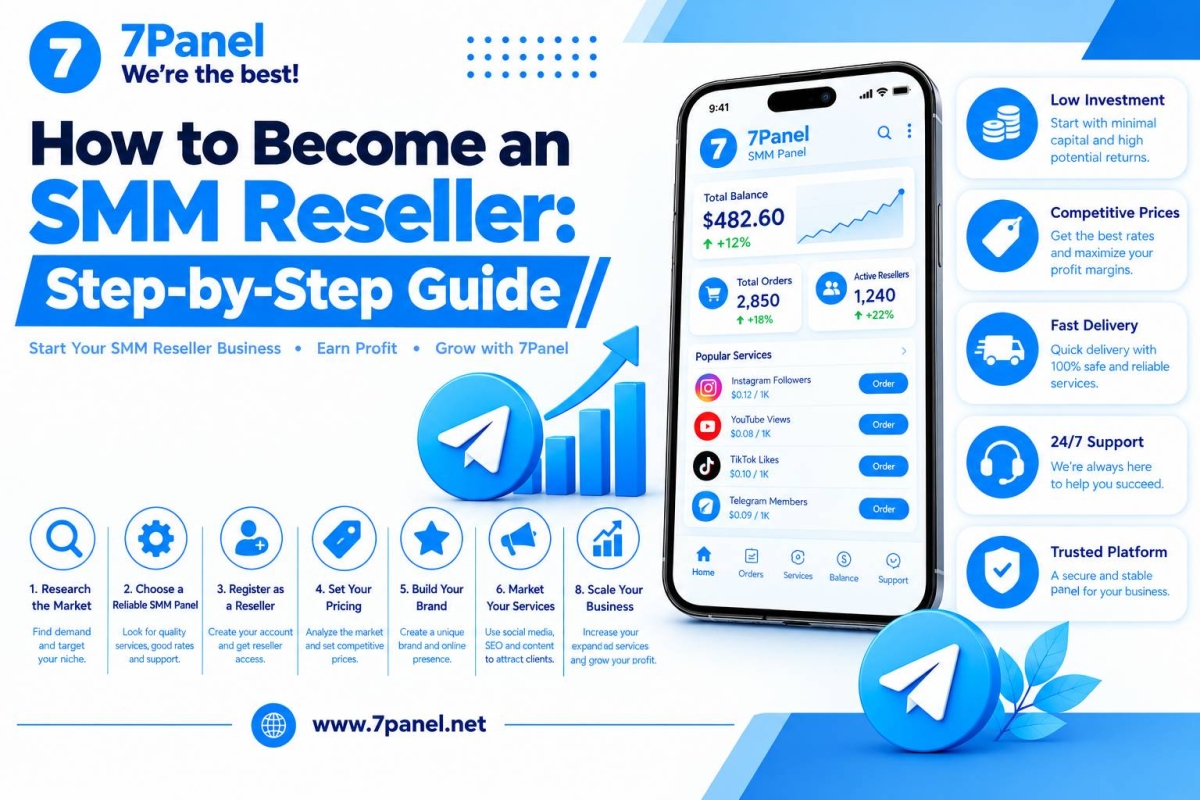
Becoming an SMM reseller may be an idea for people who wish to provide social media marketing services without having to create each service or fulfillment system by themselves.
The SMM reseller buys services from the supplier and sells them to clients at prices that ensure covering the costs and generating some profit. According to your business model, you may operate using manual order management, using an API, or having your own branded SMM website via child panel.
However, the formula of success is not only buying inexpensive services. A reliable supplier, appropriate prices, clear policies for clients, and ways to attract and keep them are also needed.
This guide will tell you everything about becoming an SMM reseller, choosing a platform, calculating your prices, and building your business.

1. Understand How SMM Reselling Works
Before starting, understand the basic business model.
An SMM reseller acts as an intermediary between a social media service provider and the end customer. You choose which services to offer, decide your retail prices, manage customer orders, and provide support.
A typical order follows this process:
- A customer visits your website or contacts your business.
- The customer selects a social media service and submits an order.
- You receive payment according to your business's payment policies.
- You place the order with your supplier, manually or through an integrated system.
- You monitor delivery and communicate relevant updates to the customer.
Your supplier handles the underlying service fulfillment, while you manage the customer relationship and the commercial side of the transaction.
For example, you might offer services related to Instagram, Telegram, TikTok, YouTube, Spotify, or other supported platforms. The available options depend on your supplier's current catalog.
2. Choose Your SMM Reseller Business Model
There are several ways to start an SMM reseller business. The best option depends on your budget, technical skills, and plans for expansion.
Option A: Resell Services Manually
You can begin by accepting orders through a website, messaging platform, or direct communication channel and submitting them to your supplier manually.
This approach can help you test demand before investing in a more developed website.
However, manual order management becomes harder as the number of customers grows. You must track payments, order details, delivery status, and customer questions carefully.
Option B: Launch Your Own SMM Website with a Child Panel
A child panel allows you to operate a customer-facing SMM website using an established provider's infrastructure rather than developing the entire platform from scratch.
Depending on the provider's features, you may be able to use your own domain and branding, set your retail prices, manage services, and handle customer orders through an administrative dashboard.
This model is useful for entrepreneurs who want to build their own brand without developing an entire ordering platform independently.
Option C: Integrate an SMM API
API integrates your website, applications, or system with those of the supplier in question and supports the services provided by the supplier.
It helps automate functions like fetching service details, submitting orders, and monitoring order status.
The API solution would be ideal for companies that already have a website or some development resources.
Suggestion: Begin with the easiest solution that fulfills your requirements. The level of automation could be increased with time as order volume increases.

3. Choose a Reliable SMM Reseller Panel Provider
Your supplier is one of the most important decisions you will make. Service problems, unclear conditions, or slow support can affect your customers and damage your reputation.
When comparing providers, look beyond the displayed price.
Check the Service Catalog
Choose a provider that offers services relevant to your target customers.
For example, if your audience primarily needs Telegram services, look for suitable Telegram options. If you plan to serve marketing agencies, a broader catalog across several social platforms may be more useful.
Check the live catalog because service availability, pricing, and requirements can change.
Compare Pricing and Order Conditions
Review each service's price, minimum and maximum order quantities, delivery information, and applicable refill, replacement, or cancellation policies.
Do not assume that two services are equivalent simply because they have similar names.
Evaluate Order Management and API Features
A good reseller workflow should make it possible to place orders and monitor their status without unnecessary manual work.
If you plan to automate operations, review the API documentation and confirm which functions are currently supported.
Check Support Availability
When an order is delayed or a customer has a question, you need a clear process for getting assistance.
Check the provider's support channels, availability, and procedures for handling service-related problems.
Compare Providers Before Committing
Create a shortlist and compare the actual features, pricing, support options, and terms offered by each provider.
A SMM reseller panel can give you access to reseller-focused tools, a catalog of services across supported platforms, centralized order management, and options for operating through a child panel or API.
Before funding your account, confirm the current service details and understand how the provider's system fits your business model.
4. Set Your Prices and Calculate Your Profit Margin
Pricing determines whether your reseller business can cover its costs and remain sustainable.

Your retail price should account for more than the supplier's service rate. Consider payment processing fees, currency conversion, customer acquisition, support time, refunds, and other operating expenses.
A basic pricing formula is:
Profit per order = Customer payment − Total order cost
For example, suppose a customer pays $10 for a service.
| Item | Amount |
|---|---|
| Customer payment | $10.00 |
| Supplier cost | $6.00 |
| Payment and other allocated costs | $1.00 |
| Estimated profit before tax and other unaccounted expenses | $3.00 |
In this example, the estimated profit is $3.00 per order before any additional expenses not included in the calculation.
This is an illustration, not a guaranteed margin. Actual results depend on the service, order outcome, payment method, customer acquisition costs, and operating expenses.
Understand Markup vs. Profit Margin
Markup and profit margin are not the same.
If a service costs you $6 and you sell it for $10, your markup on the supplier cost is approximately 66.7%. However, the gross margin before other costs is 40% of the selling price.
Use the metric that best supports your pricing decisions, and include relevant expenses when estimating the profit you actually retain.
Review Prices Regularly
Supplier rates and service conditions may change. Review your prices periodically so you can maintain a reasonable margin without making your services uncompetitive.
Avoid competing only on the lowest price. Clear service descriptions, reliable order management, useful support, and a straightforward customer experience can also help differentiate your business.
5. Build Your Website and Customer Experience
If you want to operate a recognizable reseller business, make it easy for customers to understand your services and place orders.
Your website should include:
- A clear explanation of the services you offer
- Organized categories and searchable service listings
- Transparent pricing and order requirements
- Clear payment instructions
- Customer support information
- Terms covering delivery, cancellations, and applicable refunds
- A privacy policy and other relevant business disclosures
Make sure the ordering process works on both desktop and mobile devices. Customers should be able to find the right service, understand the requirements, and track order progress without confusion.
If you are using a child panel, check the available branding, domain, payment, and administrative features before launching. If you are building your own platform, test the full process from registration and payment to order fulfillment and support.
6. Decide Which Services to Sell First
You do not need to offer every available service on the first day.
Start with a smaller selection that matches your target audience. This makes it easier to understand demand, evaluate service performance, and manage customer questions.
For example:
- Instagram services: For customers seeking supported Instagram-related promotion.
- Telegram services: For channel owners and communities looking for available Telegram services.
- TikTok services: For customers interested in supported TikTok options.
- YouTube services: For creators and businesses reviewing available YouTube services.
- Spotify services: For customers exploring supported Spotify promotion options.
These are examples rather than a recommendation to sell every category. Confirm the provider's current catalog and all applicable service requirements before listing an offer.
As your business develops, use customer demand and order history to decide which categories deserve more attention.
7. Find Your First SMM Reseller Customers
A reseller panel does not automatically bring customers to your business. You need a clear plan for reaching people who may genuinely need your services.
Create Helpful SEO Content
Publish articles that answer specific questions from your target customers.
Possible topics include:
- How to Choose an SMM Reseller Panel
- How to Compare SMM Service Prices
- How to Start an SMM Reseller Business
- How to Manage Social Media Orders for Clients
- What to Check Before Ordering an SMM Service
Each article should address a distinct search intent and link naturally to relevant service or registration pages.
Avoid publishing many nearly identical pages. Useful, original content is more valuable than repeating the same keywords across multiple articles.
Use Relevant Social Channels
Share useful guides and service information through social media accounts, professional communities, and channels where your target customers are active.
Focus on people who are likely to need your services rather than sending unsolicited promotional messages.
Offer Clear Packages
You can group relevant services into straightforward packages for a particular audience, such as small businesses, creators, or agencies.
Explain exactly what each package includes, its limitations, and how customers can request assistance.
Do not promise guaranteed engagement, permanent results, or business growth when the service cannot substantiate those claims.
Build Repeat Customer Relationships
Good customer communication can help encourage repeat business.
Provide clear order updates, respond to questions, explain limitations honestly, and handle complaints according to your published policies.
A customer who understands what they are buying is better positioned to make an informed decision.
8. Manage Orders and Customer Support Efficiently
Order management becomes more important as your business grows.
Use an organized process to record order references, customer details, payments, supplier costs, and order statuses. Protect customer information and limit access to people who need it.
When an order is delayed or only partially completed, follow the supplier's documented process and communicate relevant information to the customer.
If you use an API, test how your system handles failed requests, duplicate submissions, incomplete orders, and changes in service availability.
Automation can save time, but it does not remove the need for monitoring and customer support.
9. Common Mistakes New SMM Resellers Should Avoid
New resellers often face problems that could be reduced through planning.
Choosing a supplier based only on price: A cheap service can become expensive if unclear conditions or fulfillment problems create extra work.
Setting prices without calculating all costs: Supplier cost is only one part of your overall expenses.
Launching with too many services: A large catalog is difficult to manage before you understand demand and service requirements.
Making unsupported promises: Do not guarantee results, delivery times, or retention unless the specific service terms justify the claim.
Ignoring customer support: Unanswered questions and unclear order statuses can undermine customer trust.
Automating without testing: API errors, duplicated orders, and incorrect status updates can affect customers and finances.
Relying on one acquisition channel: A balanced approach using relevant content, referrals, partnerships, and suitable promotional channels may reduce dependency on a single source of customers.
10. How to Scale Your SMM Reseller Business
Once you have a stable ordering process and a clearer understanding of customer demand, you can consider expanding.
Start by identifying the services that generate consistent demand and can be managed within your support capacity. Review your costs, order completion patterns, customer feedback, and actual profit rather than focusing only on total sales.
You may then consider:
- Adding services that meet demonstrated customer needs
- Automating repetitive order-management tasks through supported API features
- Launching a branded child panel if it fits your business model
- Improving your website and content based on customer questions
- Creating packages for suitable customer segments
- Documenting procedures for support, refunds, and service issues
A larger catalog or more automated website does not automatically create a successful business. Expand when the underlying processes are reliable and the financial results justify the investment.
Final Checklist: Before You Launch

Use this checklist to review your readiness:
I understand the reseller business model.
I have compared supplier pricing, service conditions, and support.
I have chosen a business model: manual ordering, child panel, or API.
I have calculated retail prices using the relevant costs.
My website or ordering process is ready and tested.
My service descriptions and customer policies are clear.
I have a plan to reach relevant customers.
I can monitor orders and respond to customer issues.
I understand the limits of the services I intend to sell.
Conclusion
Getting into SMM reselling begins with picking out a proper supplier, determining your target audience, choosing correct pricing policy and creating a solid ordering system.
There are a number of ways to do that: starting off manually, working from a child panel to build your own branded site, using API integration or something else.
If you are comparing a Best SMM Reseller Panel, evaluate the current catalog, pricing, API options, child panel features, support arrangements, and service terms before committing your budget.
Focus on transparent pricing, useful customer service, and sustainable operations. These fundamentals provide a stronger foundation for an SMM reseller business than low prices or an extensive service list alone.
Frequently Asked Questions
An SMM reseller purchases social media marketing services from a provider and resells them to customers. The reseller manages retail pricing, customer relationships, order coordination, and support.
Not necessarily. You can initially manage orders through a suitable manual process. A dedicated website or child panel becomes useful when you want a branded storefront and a more structured ordering experience.
A child panel provides a ready-made customer-facing SMM website using an underlying provider's infrastructure. An API lets you integrate supported services into your own website, software, or workflow.
There is no universal starting budget. Your costs depend on the supplier, initial account funding, website or child panel setup, payment methods, marketing, and support requirements. Calculate these expenses before launching.
Resellers generally charge customers more than the total cost of providing the service. Actual profit depends on supplier costs, payment fees, customer acquisition expenses, refunds, operating costs, and taxes.
No. Revenue and profitability depend on demand, pricing, operating costs, service quality, customer retention, and effective business management. Test your assumptions and track actual results.
A child panel may be suitable if you want to launch your own branded storefront without developing a complete platform. An API may be a better fit if you already operate a website or application and need integration with supported services.
You can use helpful SEO content, relevant social media channels, professional partnerships, referrals, and clear service packages. Focus on reaching the right audience and explaining your services honestly.


Join us on Telegram
Get updates and tips on our channel.
Article tools
Share this article