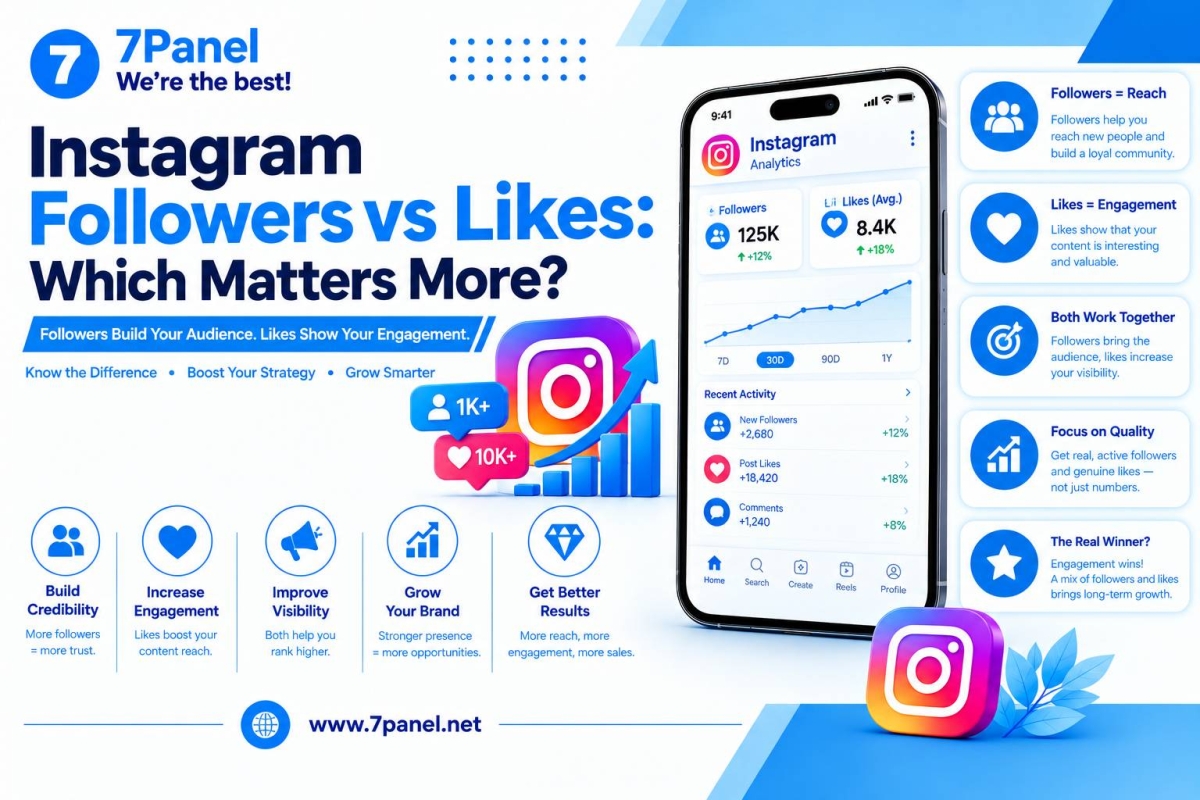
Instagram Followers vs Likes: Which Matters More?
There are various ways to measure the growth of Instagram accounts, but among the most popular metrics are followers and likes. While the former metric counts how many accounts are following your page, the latter measures how many times a post or a Reel was liked.
When trying to boost Instagram, you might ask yourself whether gaining followers should be prioritized over likes and vice versa. As always, it depends on your goals, audience, and type of account.
This article will help you understand the difference between Instagram followers and likes and choose the metric that needs more attention.

What Is the Difference Between Instagram Followers and Likes?
Instagram followers and likes measure two different things.
Instagram followers represent the accounts that have chosen to follow your profile. They can potentially see your content in their feeds, although following an account does not guarantee that every post will be shown to every follower.
Instagram likes represent reactions to individual posts, photos, videos, or Reels. They help you understand whether some viewers responded positively to a particular piece of content.
Here is a simple comparison:
| Feature | Instagram Followers | Instagram Likes |
|---|---|---|
| What they measure | Profile audience size | Reactions to a post |
| Where they appear | Your profile | Individual posts and Reels |
| Main purpose | Building an audience | Measuring one form of engagement |
| What they can indicate | Potential audience size | Interest in specific content |
| Main limitation | Followers may not interact | Likes do not prove business results |
| Best used for | Tracking audience growth | Comparing content performance |
Neither metric tells the whole story. A successful Instagram strategy considers audience growth, content engagement, reach, shares, saves, and the results that matter to the account owner.
Why Are Instagram Followers Important?
Followers help establish the size of your Instagram audience. When someone visits your profile, the follower count is one of the visible indicators they may consider when deciding whether to explore your content or follow you.

1. They Help You Build an Audience
A growing follower count can indicate that your content is attracting new people. For creators, businesses, and personal brands, building a relevant audience is an important step toward developing long-term relationships.
However, the quality of your audience matters. A smaller group of people who genuinely care about your content may be more valuable than a much larger audience that rarely interacts with it.
2. They Can Support Social Proof
Social proof is the way people use visible information about others' choices when forming an impression. A profile with an established audience may appear more familiar or credible to some visitors.
But follower count alone does not establish trustworthiness. Visitors may also evaluate the quality of your posts, the relevance of your content, the comments you receive, and how professionally you communicate.
3. They Create Opportunities for Long-Term Engagement
Followers provide a potential audience for future posts, Reels, Stories, and announcements. If they find your content useful or entertaining, they may continue interacting with your account over time.
That opportunity depends on maintaining content quality and audience relevance. Followers who no longer find your posts useful may stop interacting, even if they remain on your follower list.
4. They May Support Business and Creator Goals
For businesses and creators, a relevant audience can create opportunities to promote products, build brand awareness, attract enquiries, and develop partnerships.
Still, the number of followers does not automatically translate into sales or revenue. Results depend on the audience's interests, the offer, content quality, and the path from discovery to action.
Why Are Instagram Likes Important?
Likes measure reactions to individual pieces of content. They can help you compare posts and understand which topics or formats attract positive responses.

1. They Help You Evaluate Content
Suppose you publish two posts about the same product. One receives considerably more likes than the other.
That difference may indicate that one post appealed to more viewers, but it does not explain why. The image, caption, timing, topic, audience reach, and other factors may all have contributed.
Compare likes alongside reach and other interactions to get a more useful picture of performance.
2. They Show One Form of Audience Interaction
A like is a simple action that allows users to react to content. When your existing audience regularly likes your posts, it can be one indication that some followers are responding to what you publish.
However, likes are only one form of engagement. Comments, saves, shares, Story replies, and other interactions can provide additional information about how people respond to your content.
3. They Help You Compare Similar Posts
Tracking likes across similar posts can help you identify patterns. For example, a food creator may discover that recipe videos receive more likes than static menu images.
To make a fair comparison, consider how many accounts each post reached and whether the posts used similar formats. A post shown to more people may receive more likes simply because it had more opportunities to be seen.
4. They Can Contribute to Content Discovery
Instagram uses multiple signals to rank and recommend content. Likes are one signal, but they are not the only factor determining distribution.
Instagram has explained that ranking signals differ across surfaces and that likes can be relevant when predicting interest, particularly among people who already follow an account. Shares, watch time, and other signals also matter depending on the content and audience.
For that reason, increasing likes should not be treated as a guaranteed way to make a post viral.
Instagram Followers vs Likes: Which Is Better for Growth?
There is no universal winner. Followers and likes serve different purposes, so the better metric depends on what you want to achieve.
Choose Followers When Your Goal Is Audience Growth
Follower growth deserves attention if you want to build an audience over time.
This is particularly relevant for:
- New creators building their first audience.
- Businesses developing brand awareness.
- Personal brands establishing a presence in a particular niche.
- Accounts that publish content intended to attract recurring viewers.
Track your net follower growth over time rather than looking at one isolated number. Also consider whether new followers match your target audience and whether they continue interacting with your content.
Choose Likes When Your Goal Is Evaluating Post Engagement
Likes can be useful when you want to understand how people respond to individual posts.
They are especially helpful when:
- Comparing similar pieces of content.
- Testing different visual styles or topics.
- Evaluating reactions to product announcements.
- Identifying posts that may deserve further analysis.
Do not compare likes alone across posts with very different reach. A post that receives fewer likes but reaches a much smaller audience may actually have a stronger response relative to its reach.
Consider Both When Building a Brand
For many creators and businesses, the best approach is to monitor both metrics.
Followers help you understand audience growth. Likes help you evaluate reactions to individual posts. Together, they provide more context than either number alone.
Even so, a broader analysis should include reach, shares, saves, comments, profile visits, website clicks, and conversions when those metrics are relevant to your goals.
Instagram Followers vs Likes: A Practical Example
Imagine two Instagram accounts with different results.
| Metric | Account A | Account B |
|---|---|---|
| Followers | 10,000 | 4,000 |
| Likes on a particular post | 100 | 240 |
| Likes as a percentage of followers | 1% | 6% |
In this hypothetical example, Account A has a larger audience, but Account B receives more likes on the selected post relative to its follower count.
This does not automatically make Account B more successful. The calculation uses follower count rather than actual reach, and not every follower sees every post. It also excludes comments, saves, shares, business results, and other relevant factors.
The example illustrates why follower count and likes should be interpreted separately instead of treating one as a complete measure of success.
How to Improve Instagram Followers and Likes Naturally
If you want to improve both metrics, focus on attracting the right audience and creating content people genuinely want to see.
1. Create Content for a Clear Audience
Identify your target audience and the topics they care about. A fitness creator might publish workout demonstrations, while a small business could share product tutorials, customer questions, and useful buying advice.
Content designed for a specific audience is easier to evaluate and improve than content published without a clear purpose.
2. Improve Your Profile
Make sure your username, profile photo, bio, and pinned posts communicate what your account offers.
When visitors understand the value of following you, they have a clearer reason to become part of your audience.
3. Publish Consistently
Develop a realistic publishing schedule that you can maintain. Consistency helps you test different topics and formats while giving your audience more opportunities to discover useful content.
The best schedule is one that allows you to maintain quality rather than publish frequently at the expense of relevance.
4. Make Reels Useful and Engaging
Reels can help introduce your content to people who do not already follow your account. Focus on a clear opening, an interesting topic, and a video that delivers on its promise.
Avoid adding unnecessary introductions that delay the main point. Make the content easy to understand and worth sharing.
5. Encourage Meaningful Interaction
Ask relevant questions, respond to comments, and create content that people may want to save or share with friends.
Avoid repetitive engagement bait that offers little value. Meaningful interaction provides more useful feedback than simply trying to increase a visible number.
6. Use Instagram Insights
If you have access to Instagram Insights, review the metrics available for your account and content.
Depending on your account and content format, useful metrics may include:
- Accounts reached.
- Likes and comments.
- Saves and shares.
- Follower growth.
- Profile visits.
- Website clicks and other tracked actions.
Review trends across multiple posts instead of making decisions based on a single result.
Should You Focus on Followers or Likes When Using Instagram Marketing Services?
Some creators and businesses explore third-party marketing services while planning their Instagram promotion. Before choosing any service, determine whether your objective is to build an audience, promote a particular post, or achieve a measurable business outcome.
An Instagram SMM Panel can be one option to research when comparing available Instagram services, pricing, and order conditions. Check each service's description carefully and understand what it does before making a decision.
If your main goal is to promote individual posts, review the available options against the content you want to promote. If your priority is audience development, consider your target audience, publishing strategy, and the relevance of the followers you hope to attract.
You can also explore Instagram growth services to review the available options. Remember that third-party services cannot guarantee genuine engagement, organic reach, sales, or long-term account growth.
Never share your Instagram password or login verification codes with a service provider. Review applicable Instagram policies and the provider's terms before placing an order.
Common Mistakes When Comparing Followers and Likes
Avoid these common mistakes when evaluating Instagram performance.
Treating a Large Follower Count as Proof of Success
A high follower count does not guarantee that people are interested in your content or that your business will generate more sales.
Assuming Every Like Represents a Potential Customer
A like indicates a reaction, not a purchase intention. Business performance should be evaluated using appropriate measures such as enquiries, website actions, leads, and sales.
Comparing Posts Without Considering Reach
Posts reach different numbers of people. Comparing raw likes without considering reach can produce misleading conclusions.
Ignoring Shares and Saves
Some people may find content useful enough to save or valuable enough to share without liking it. Looking only at likes can therefore overlook other meaningful responses.
Chasing Numbers Instead of Setting Goals
Before investing time or money in growth, decide what success means for your account. Your priorities may be audience growth, stronger engagement, more qualified enquiries, or increased sales.
A clear objective makes it easier to choose relevant metrics and assess whether your strategy is working.
Frequently Asked Questions
Not in every situation. Followers measure audience size, while likes measure reactions to individual posts. Followers may be more relevant when tracking audience growth, whereas likes can help evaluate how people respond to particular content.
Likes may help you identify content that resonates with viewers, and engaging content can contribute to discovery and new follows. However, likes alone do not guarantee that more people will discover or follow your account.
Yes. An account can have a large follower count and receive relatively few likes. This may reflect differences in audience interest, content relevance, reach, posting habits, or other factors. Compare multiple metrics before drawing conclusions.
There is no single ideal number for every account. Results vary with audience size, content format, niche, reach, and audience behavior. Compare your posts over time and use engagement relative to reach when the relevant data is available.
Businesses should choose metrics according to their goals. Followers can help measure audience development, while likes provide one indication of how people respond to content. For commercial goals, also track enquiries, website visits, leads, and sales.
Before using any paid or third-party engagement service, consider Instagram's rules, the provider's terms, and the risk of inauthentic engagement. Artificially increasing visible counts does not guarantee genuine interest, organic reach, or sales. Building relevant audiences and publishing useful content should remain central to your strategy.
Conclusion
If you compare Instagram likes vs followers, it is important to bear in mind that both numbers tell about different things.
While the followers metric helps measure the size of your audience, likes are an example of how people react to your particular content. It goes without saying that just having many followers does not mean anything if the engagement level is low, and vice versa.
To grow your Instagram account sustainably, it is recommended to consider all of the metrics together, including reach, shares, saves, and comments.
The best metric is the one that helps you measure progress toward your actual goal—not simply the number that looks biggest on your profile.




Join us on Telegram
Get updates and tips on our channel.
Article tools
Share this article